
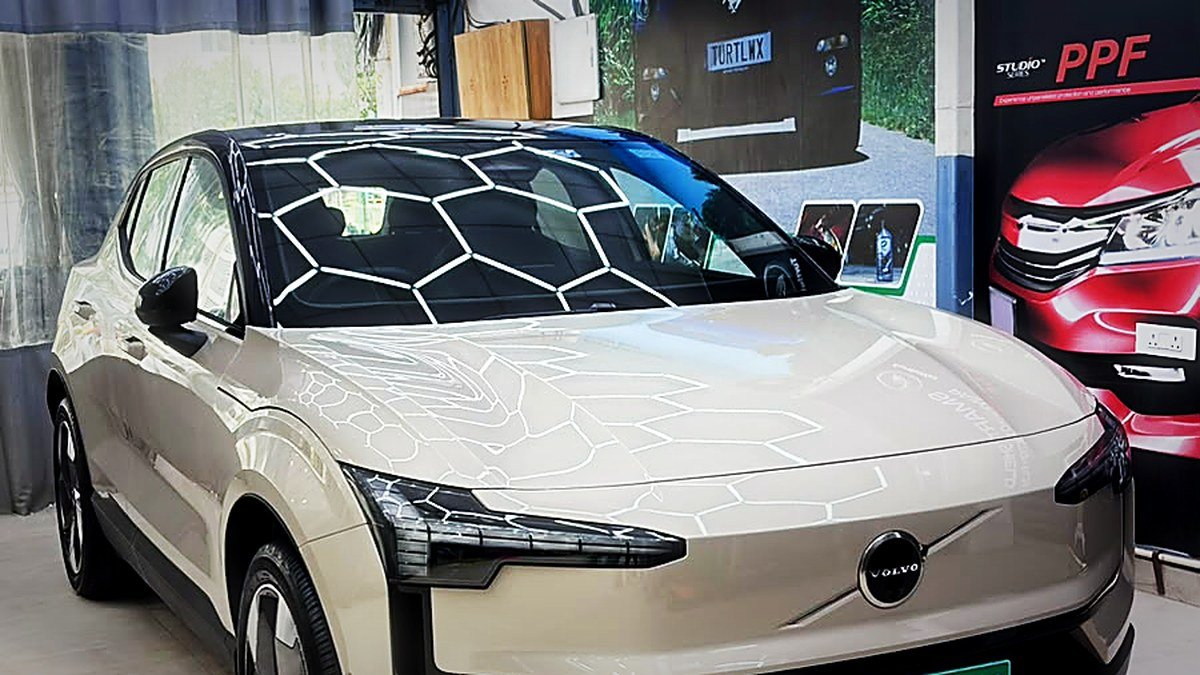
Electric vehicles are selling fast in India, with Tata, Mahindra, Kia and others launching new models every year. Most EV buyers plan to keep the car for a long time, because an EV asks for far less routine mechanical maintenance than a petrol or diesel car. But when you intend to keep something for a decade, the paint deserves the same forward planning as the drivetrain.
EV owners keep their cars longer, and EV paint has a harder life than most people expect — these are heavy cars that spend a lot of time on highways, and body panels on many EVs are large, flat and unforgiving of chips. The best moment to protect that paint is while it is still perfect.
Why PPF matters for long-term EV ownership
Paint protection film is one of the most effective ways to protect a car's original paint from everyday damage. In normal driving your paint meets small stones, road debris, dust, minor scratches, bird droppings and every other contaminant the road throws at it. A good film sits above the paint and takes that damage instead.
Premium films add self-healing and hydrophobic behaviour, so light surface marks relax out with heat and the surface stays easier to clean. If you want the detail on how films differ, our guide to PPF thickness covers what actually determines performance.
Keeping your EV looking new for longer
For anyone planning to keep a car for several years, appearance is not vanity — it is part of the car's condition, and it is the part a future buyer sees first. Mechanical maintenance keeps an EV running; paint protection keeps it looking like a car worth what you paid.
Film adds a protective layer over the original paint. With sensible washing it helps the car hold its gloss and finish for far longer than bare clear coat would. So PPF is not simply about making a new car look good on day one. It is a long-term investment in the paint underneath.
Does every EV brand need PPF?
Whether you drive a Tata, Mahindra, Kia or any other EV, film is worth considering if you want long-term paint protection. The brand matters less than how and where you drive.
Choosing the right film is the part that needs thought. Thickness, material quality, warranty, installation standard, after-sales support and your own usage should all feed into the decision. Choosing purely on the lowest price rarely ends well — the film and the fitting matter equally, and a cheap fit on a good film still looks like a cheap fit.
A note on EV-specific considerations
- Large flat panels. Many EVs have long, smooth bonnets and doors with minimal creasing. That makes for a clean film installation, but it also means a single chip sits in the middle of an uninterrupted surface where you cannot miss it.
- Weight and highway use. EVs are heavy and quiet, which encourages higher sustained speeds. Faster impacts mean deeper chips.
- Paint repairs are disruptive. Any panel repair on an EV means working around high-voltage components, which makes body shops more cautious and jobs slower.
- Charging means more time parked outside. Cars sat at public chargers spend more hours in direct sun and in car parks where doors open next to them.
Just bought an EV?
This is the ideal moment for film — while the paint is still factory-fresh. Bring it in for a free inspection and we will talk through coverage options honestly.
Our recommendation for EV owners
If you plan to keep your EV for five to ten years or longer, film is worth serious consideration — and the best time to fit it is when the car is new.
Applying film while the original paint is still in excellent condition means you are protecting a perfect surface rather than sealing in damage that is already there. On an older car we would recommend paint correction first, which adds cost and time. Doing it at delivery avoids that entirely.
Many EV owners pair front-end film with a ceramic or graphene coating over the rest of the car: chip protection where chips land, and an easy-clean, glossy surface everywhere else. Our comparison of PPF and ceramic coating explains where each one earns its place.
Frequently asked questions
Is PPF different for electric cars?
The film itself is the same. What differs is the case for fitting it: EV owners typically keep their cars longer, the panels tend to be large and flat so a chip is very visible, and body repairs are more disruptive because of the high-voltage systems the shop has to work around.
When is the best time to fit PPF on a new EV?
As close to delivery as possible, while the paint is still perfect. Film protects what is underneath it — fitting it later means either accepting existing marks or paying for paint correction first.
Does PPF affect an EV's range or charging?
No. The film is a few thousandths of a millimetre thick and adds negligible weight. It has no effect on aerodynamics, range or charging.
Should I film the whole car or just the front?
Most owners start with the front end — bonnet, bumper, fenders and mirrors — because that is where stone chips actually land. Full-body film gives complete coverage and suits cars being kept long term. We will recommend based on how and where you drive.
Can I add a coating on top of PPF on my EV?
Yes, and it is a popular combination. A ceramic or graphene coating over the film makes washing easier and protects the film itself from staining and water spots.
Final thoughts
EVs suit long-term ownership precisely because they ask so little of you mechanically. When you plan to keep a car for many years, protecting the exterior becomes a proportionally larger part of keeping it in good condition.
So whether your EV is a Tata, Mahindra, Kia or anything else — if the goal is to keep it looking newer for longer, a good-quality film fitted properly is a genuinely smart long-term investment. Get a free quote for your car